 EN
 English
 عربى

ShuJia
ShuJia
ShuJia
ShuJia
ShuJia
ShuJia
ShuJia
ShuJia
ShuJia

Product Category
NEW Category
Contact us
Contact Us
We specialise in the research, development and manufacture of electrical wires and cables.
 +86-13472882970 (Mr. Zhang)
29 CFR 1910.106 Flammable Liquid Storage Cabinets: Practical Lab Guide
Content
Flammable liquids are part of everyday lab life, from solvent bottles on a shelf to mobile phases in a chromatography room. It is easy to focus on the experiment and treat storage as a background detail. But 29 CFR 1910.106, OSHA's flammable liquids standard, treats storage cabinets as a safety control with specific limits and design expectations. This guide walks through the cabinet requirements in plain language and shares the practical checks we use when reviewing lab storage layouts.
This is a summary, not legal advice. Always confirm current requirements with OSHA, your local fire authority, and your organization's safety team.
What 29 CFR 1910.106 Says About Storage Cabinets
At its core, 29 CFR 1910.106 is about keeping flammable liquids under control. The standard addresses containers, tanks, inside storage rooms, and storage cabinets. For cabinets, OSHA sets a performance baseline: the cabinet must be designed and constructed to have a fire resistance rating of at least 10 minutes. That does not mean a cabinet can survive any fire. It means the cabinet is built to give people time to react and to keep the contents from feeding a fire during the early minutes.
The rule also sets a clear quantity limit. Not more than 60 gallons of Category 1, 2, or 3 flammable liquids, nor more than 120 gallons of Category 4 flammable liquids, may be stored in a storage cabinet. Those limits are per cabinet, not a permit to fill the room. Local fire codes and NFPA 30 may add limits.
Capacity Limits at a Glance
OSHA's cabinet limits are based on the liquid category, not on the size of the cabinet or how neatly the containers fit. Use the table below as a quick field reference, then verify the category of every product you store.
| Liquid category | Maximum per cabinet | Practical note |
|---|---|---|
| Category 1, 2, or 3 | 60 gallons (about 227 L) | Combined limit for these categories in one cabinet. |
| Category 4 | 120 gallons (about 454 L) | Higher limit, but still subject to room and fire code limits. |
The key word is "stored." If a cabinet is overflowing or doors will not close, the limit has little value. Keep the cabinet closed and the contents within capacity.
Construction and Labeling Details That Matter
A compliant cabinet is more than a metal box with a sticker. OSHA's 10-minute fire resistance rating is the baseline; typical listed cabinets use double walls, a 1-inch airspace, and tight-latching doors to limit heat transfer. Look for a clear label and documentation that ties the model to the standard.
Labeling is part of the requirement. The cabinet should be marked in conspicuous lettering with "Flammable - Keep Fire Away." That label tells everyone what is inside and helps first responders make faster decisions.
Vent openings deserve attention. OSHA requires cabinet vent openings to be sealed with the bungs provided unless the cabinet is connected to an approved exhaust system. It is common to see a cabinet under a fume hood with the bungs removed "for airflow." That can defeat the fire resistance. If the cabinet is not connected to approved exhaust, keep the vents sealed. If it is connected, make sure the exhaust is designed, installed, and maintained as part of the system.
Location, Ventilation, and Daily Use
Where a cabinet sits matters as much as how it is built. 29 CFR 1910.106(d)(5) requires that flammable liquids not be stored in a way that limits use of exits, stairways, or areas normally used for safe egress. Do not park a cabinet in a corridor, in front of an exit, or where people must squeeze past it during an emergency. Keep it away from ignition sources and give the doors room to open fully.
Ventilation is often misunderstood. OSHA does not require every flammable storage cabinet to be vented. If a cabinet is vented, the connection must be to an approved exhaust system designed for the job. A common mistake is to vent a cabinet into general room exhaust and assume that solves the problem. It may help with odors, but it can change the fire performance of the cabinet and the pressure balance of the lab.
For non-flammable corrosive reagents and vessel storage, a ventilated PP cabinet can be a useful complement. It can help control odors and keep containers organized, but it is not a substitute for a fire-rated cabinet for flammable liquids.
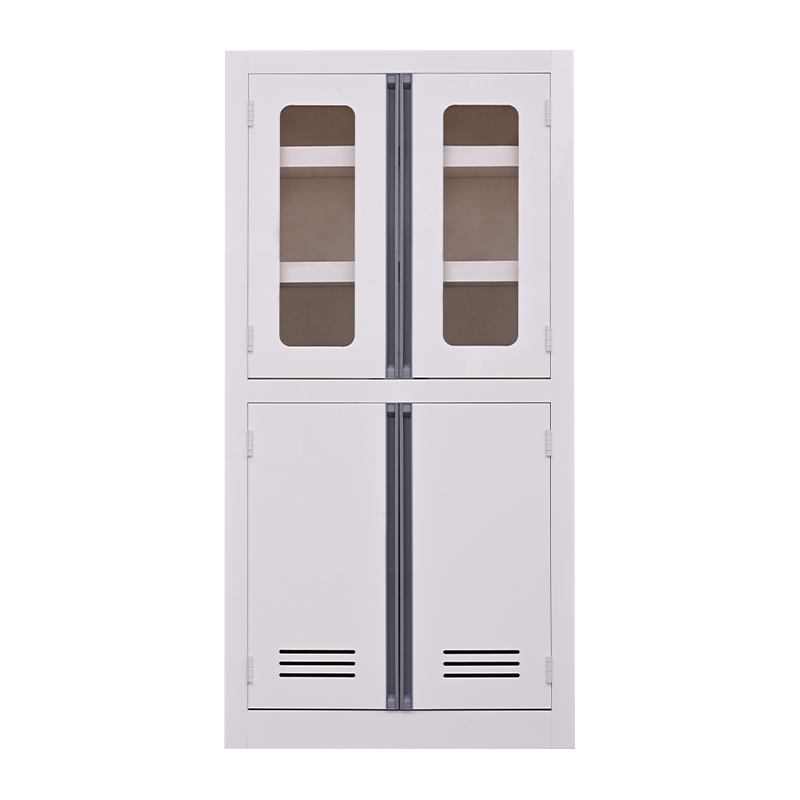 PP Ventilated Reagent and Vessel Storage CabinetCorrosion-resistant polypropylene cabinet with independent ventilation per compartment, suited to non-flammable corrosive reagents and organized vessel storage where fume control and acid/alkali resistance matter.View Product →
Dispensing is the other daily-use issue. Bonding and grounding are not optional when you pour from one container into another. Static discharge can ignite vapors. Keep containers closed when not in use, use approved safety cans where required, and train staff to stop and ask when a container is damaged or a label is missing.
Cabinet Storage vs. Inside Storage Rooms
Cabinets are convenient, but they are not the only option, and they are not intended to hold unlimited quantities. When a lab needs more flammable liquid storage than a cabinet can safely provide, the next step is usually an inside storage room. OSHA's requirements for inside storage rooms cover fire-rated construction, ventilation, electrical classification, and other details that go beyond a single cabinet.
This is where planning pays off. If you are adding a second cabinet, check room-level limits and the local fire code first. If you are converting a closet into a storage room, do not assume a coat of paint and a vent fan will do the job. The electrical classification, wall fire rating, and exhaust path all matter. For larger storage areas, a custom ventilation room can separate storage from work zones while keeping airflow under control.
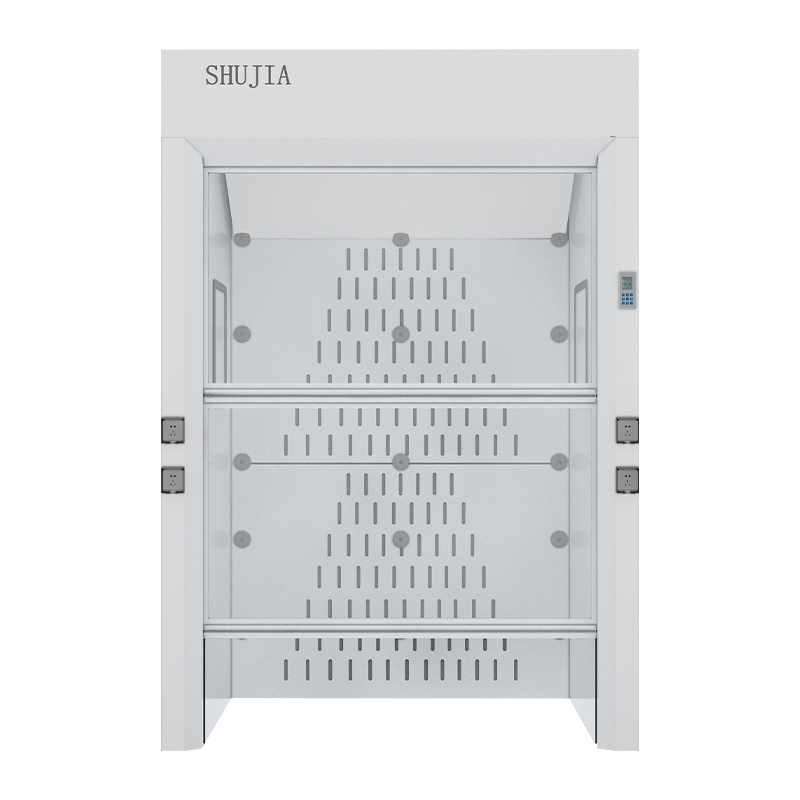 Customized Walk-In Ventilation Room for Chemical Storage and SynthesisWalk-in polypropylene enclosure with reinforced frame, sliding doors, and staged airflow, suited to kilogram-scale synthesis, large instruments, and temporary waste-liquid storage.View Product →
A Practical Compliance Checklist for Lab Teams
Use this list as a starting point for a walkthrough. It is not a substitute for a full risk assessment, but it catches the issues we see most often.
- Confirm the category and quantity of every flammable liquid, and keep the total within OSHA's cabinet limits.
- Verify the cabinet label and fire resistance documentation.
- Keep vents sealed unless connected to approved exhaust.
- Move the cabinet out of exits and egress paths.
- Use bonding and grounding when dispensing, and keep containers closed.
- Inspect latches, hinges, and seals; repair or replace damaged cabinets.
- Review room limits, local fire codes, and NFPA 30 before adding capacity.
- Train staff on what belongs in the cabinet and whom to call when something looks wrong.
For related local exhaust questions, our fume hood buyer's checklist can help you ask better questions before a purchase.
Where Our Experience Can Help
We have worked with universities, biopharma companies, public health labs, third-party testing labs, and petrochemical clients on laboratory furniture, ventilation, and waste gas treatment. That work has taught us that storage problems are rarely just about the cabinet. They involve the room, the airflow, the people, and how the lab actually operates.
Our team participated as a core unit in two industry standards: T/SLEA 0011-2023 for laboratory fume hoods and T/SLEA 1011-2023 for laboratory design and construction, Part 1: General technical requirements. We are also a council member of the Shanghai Laboratory Equipment Association and the Shanghai Laboratory Indoor Environment Purification Industry Association, and a member of the China Pharmaceutical Engineering Design Association. That background helps us treat a storage layout as a system, not a shopping list.
If you want a second set of eyes on your layout, talk with our team. We can review cabinet placement, ventilation connections, and exhaust treatment options without turning the conversation into a sales pitch.
Flammable liquid storage cabinets are one of those quiet safety controls that only get noticed when something goes wrong. The basics from 29 CFR 1910.106 are not complicated: respect the capacity limits, use a fire-rated and properly labeled cabinet, keep vents sealed unless approved exhaust is connected, and keep the cabinet out of egress paths. Add good housekeeping and training, and you have a storage setup that supports the science instead of creating a hidden risk.
PREV:No previous article
NEXT:Acid and Flammable Cabinets: How to Choose, Vent, and Store Them Safely
NEXT:Acid and Flammable Cabinets: How to Choose, Vent, and Store Them Safely
Interested in cooperation or have questions?

GET A QUOTE
Products
Website:
Wechat:

Quick Links
Contact Us
-
E-mail:
Sales@shujialab.com
-
Phone:
+86-13472882970 (Mr. Zhang)
-
Address:
Unit D, 3rd Floor, Building 2, 777 Zhenyan Road, Zhangyan Town, Jinshan District, Shanghai, China
- Social Media Links:
Fill out our contact form and we'll connect you with the people who can help.
Copyright © Shanghai Shujia Environmental Protection Engineering Co., Ltd.
All Rights Reserved.
 Laboratory Ventilation Equipment Manufacturers